
Denmark gave the world some of its most recognised furniture design. Yet walk through the factories behind today’s Danish brands and you will rarely find them in Denmark. Most production has moved abroad, and the labels now read “designed in Denmark” rather than “made in Denmark”.
This shift has little to do with quality and everything to do with economics. Manufacturing furniture in Denmark has become one of the most expensive options in Europe. Here are the four costs that pushed production out, and where it went.
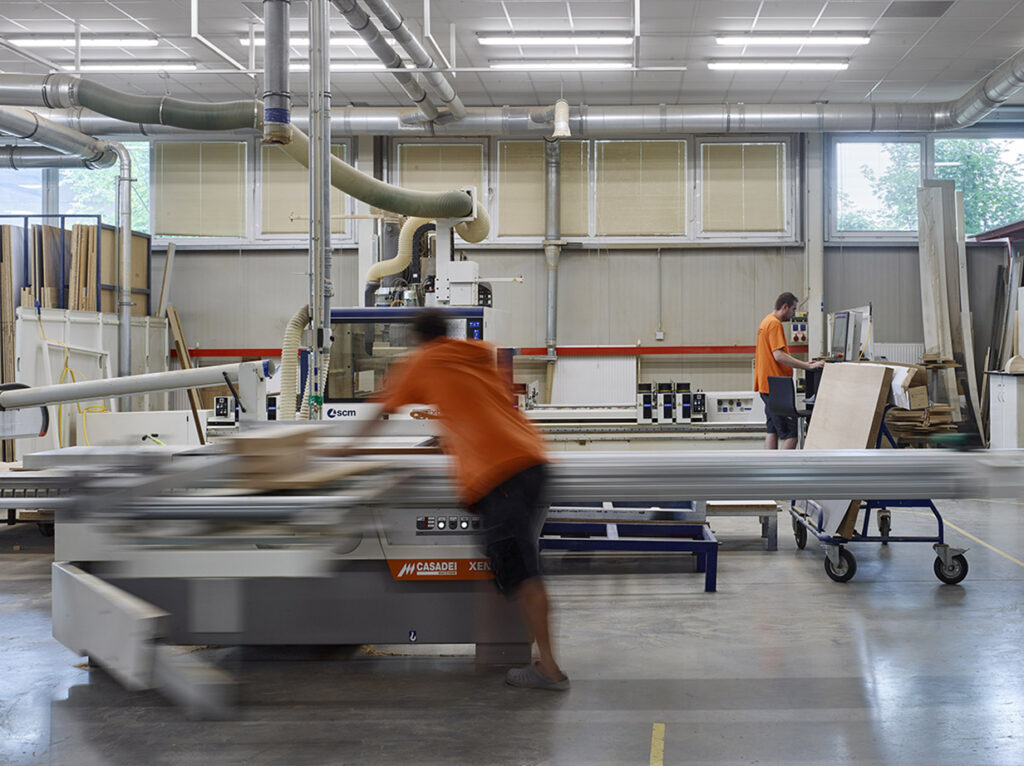
1. The highest salaries in European manufacturing
Labour is the largest single cost in furniture production, and Denmark sits at the top of the European table.
According to Eurostat’s 2025 figures, average hourly labour costs in Denmark reached €51.70, the highest in the EU and well above the EU average of €34.90. For comparison, the same hour of work costs €16.30 in Latvia and €17.80 in Lithuania.
Denmark has no statutory minimum wage, but collective agreements cover most of the workforce and add pension contributions, paid holiday and overtime rules on top of base pay. A skilled joiner or CNC operator in Denmark costs a factory roughly three times what the same specialist costs in the Baltics.
On a fitted kitchen or a production run of upholstered chairs, that difference alone can decide whether a product is competitive at retail.
2. Higher overheads for every factory
Salaries are only the visible part. Running a production facility in Denmark carries some of the heaviest overheads in Europe.
Industrial rent and property prices around Copenhagen and Aarhus are among the highest on the continent. Electricity for industrial users in Denmark has consistently ranked among the most expensive in the EU, which matters in a business built on kilns, CNC machining centres, spray booths and climate-controlled storage. Add insurance, certification and administrative compliance, and the cost of simply keeping the lights on rises before a single panel is cut.
Overheads scale with every unit produced. Even a well-run Danish factory starts each quote at a structural disadvantage against a comparable plant two hours away by air.
3. More expensive materials
Denmark is a design nation, not a timber nation. Forest covers only around 15% of Danish territory, so Danish factories import most of their industrial wood, often from the Baltic states and Scandinavia.
Every imported board, veneer and fitting carries transport, handling and intermediary costs by the time it reaches a Danish workshop. Compare that with Latvia, where forest covers 53% of the country and FSC-certified timber travels a short truck ride from forest to sawmill to factory.
When your raw material is grown, cut and machined in someone else’s supply chain, you pay their margin at every step. Furniture brands noticed this and moved production closer to the source.
4. A heavier tax burden
Denmark funds one of the world’s most generous welfare states, and manufacturing carries its share of the bill. Corporate income tax stands at 22%, labour taxation is among the highest in the OECD, and energy and environmental levies add further cost to every production hour.
None of this is a flaw in the Danish model. It is a choice, and it works well for a service and knowledge economy. But for margin-driven manufacturing, the arithmetic is unforgiving. Each layer of tax widens the gap between a Danish factory gate price and one from Poland or the Baltics, for an identical product built to identical standards.
What this means for “Danish design”
Danish brands did not abandon quality when they moved production. Design, engineering and brand management stayed in Copenhagen; the machinery, and much of the craftsmanship, moved to Poland, Lithuania and Latvia.
Many Baltic factories spent decades producing for Scandinavian brands under private label agreements. They work with the same materials, hardware and finishing systems as Western European plants, often bought from the same suppliers. The label changed. The standards did not.
Lower the costs and outsource manufacturing to Latvia
The economics that moved Danish production abroad apply to every European furniture brand: the question is no longer whether to manufacture outside high-cost markets, but where, and with whom.
The Baltics offer Western European quality standards, EU contract law and euro invoicing at roughly a third of Danish labour costs, close enough to visit in a morning. We covered the full case in 5 Reasons to Manufacture Your Furniture Products and Interiors in the Baltics.
The practical challenge is finding the right factory for your specific products. That is what we do at Gauya Furniture: we connect brands, architects and developers with trusted, vetted factories in Latvia and manage the project from design and prototyping through to production, delivery and installation.