
Demand for Scandinavian kitchens has never been stronger. Across Sweden, Denmark, Norway, the United Kingdom and Germany, buyers are drawn to the same qualities: clean lines, light woods, honest materials and intelligent storage. Yet the brands selling these kitchens face a persistent problem. Manufacturing in Scandinavia itself has become expensive, capacity is limited and lead times keep growing.
There is a proven alternative. Gauya manufactures Scandinavian style kitchens in Latvia, roughly 300 kilometres across the Baltic Sea from Stockholm. We work with the same timber, apply the same design principles and meet the same European quality standards, at a production cost that allows our clients to remain competitive. This article explains what defines a Scandinavian kitchen, why so many brands now produce theirs in the Baltics, and how private label kitchen manufacturing works in practice.
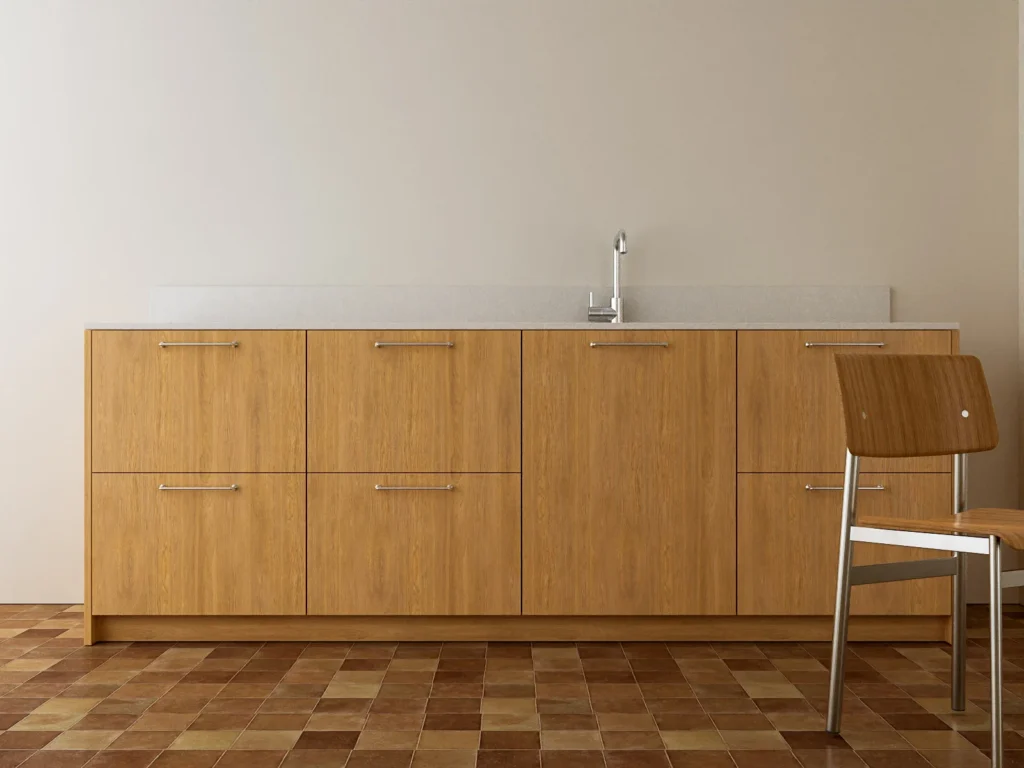
What Defines a Scandinavian Kitchen?
For a professional buyer, “Scandinavian” is more than an aesthetic label. It is a set of design and engineering decisions that shape how a kitchen is specified, produced and delivered.
The visual language is minimalist: handleless or discreetly handled fronts, matte or softly lacquered surfaces, and a restrained palette of whites, greys and muted naturals. Light woods dominate, particularly oak, birch and ash, used both as solid timber and as high quality veneer. Function carries equal weight to form. Scandinavian kitchens are planned around storage efficiency, ergonomic working heights and hardware that performs for decades rather than years.
Just as important for retailers and developers, the Scandinavian tradition is closely tied to flat pack engineering. Cabinets are designed for efficient transport and rapid assembly on site, which reduces logistics costs and simplifies installation at scale. A manufacturer that understands this tradition builds it into the product from the first drawing, not as an afterthought.
Why Kitchen Brands Are Moving Production from Scandinavia to the Baltics
The economics of Nordic manufacturing have shifted decisively over the past two decades. Labour costs in Sweden and Denmark are among the highest in Europe, industrial capacity is constrained, and many heritage factories have closed or moved. We examined this shift in detail in our article on why furniture brands no longer manufacture in Denmark, and the same forces apply to kitchens.
The Baltics offer a rare combination of advantages. Latvia sits on the same timber belt that has always supplied Scandinavian workshops. Baltic birch is prized worldwide for its strength and consistency, and locally sourced oak and ash meet the exacting grading standards Nordic designers expect. The region shares a design culture with Scandinavia, shaped by decades of manufacturing for Swedish, Danish and Norwegian brands. Skilled cabinetmakers, modern CNC production lines and rigorous quality management are the norm rather than the exception.
Then there is geography. Riga is closer to Stockholm than Munich is to Hamburg. Ferry and road connections put finished kitchens in Scandinavia within days, and the United Kingdom, Germany and the Netherlands are served by established EU freight corridors with no customs friction inside the single market. For a fuller picture of the regional case, see our overview of the five reasons to manufacture furniture in the Baltics.
The result is straightforward: the same Scandinavian kitchen, produced to the same standard, at a cost structure that protects your margin.
Private Label Kitchen Manufacturing: Your brand, product made by Gauya
Most of our kitchen production is private label. Our clients sell under their own brand; we remain invisible to their end customers. The process follows six stages.
1. Design brief. You bring drawings, a mood board or an existing range you wish to reproduce or evolve. Our engineers review the brief for manufacturability and suggest optimisations for cost, durability and transport.
2. Prototyping. We produce full prototypes of key cabinets and fronts. This is where finishes, edge details, hardware and tolerances are agreed before any volume commitment.
3. Materials and finishes. Together we specify carcass materials, front constructions, veneers, lacquers and worktop options. We advise on where solid timber adds value and where engineered boards perform better.
4. Production. Manufacturing runs on modern CNC lines with in process quality checks at every stage, from panel cutting through edging, drilling, finishing and hardware fitting.
5. Quality control. Every batch passes final inspection against the agreed specification, covering dimensions, finish quality, hardware function and packaging integrity.
6. Flat pack delivery. Kitchens are packed for efficient palletisation and protected transport, labelled to your requirements and shipped on your schedule.
You can read more about our approach on our private label furniture manufacturing page.
Materials, Certifications and Quality Standards
Professional buyers in the Nordics, the United Kingdom and Germany rightly demand documented standards, and we build our production around them.
Our timber and board materials are available FSC certified, giving your brand a verifiable chain of custody from forest to finished kitchen. Board materials meet E1 formaldehyde emission requirements as standard, and lower emission specifications are available where your market requires them. All products comply with applicable EU regulations, and finishes are tested for resistance to moisture, heat and everyday wear, the conditions that define a kitchen’s working life.
Beyond certificates, quality is a matter of process. Incoming materials are inspected before they enter production, critical dimensions are verified during machining, and finished components are checked again before packing. Our clients audit us regularly, and we welcome it.
Order Volumes, Lead Times and Logistics from Latvia
Practical questions decide partnerships, so here are direct answers.
Minimum order quantities are flexible and depend on the complexity of the range. We regularly serve growing brands whose volumes would not interest the largest factories, as well as established retailers with continuous production programmes. Typical lead times run from a few weeks for repeat production to somewhat longer for new ranges that require prototyping and tooling.
On logistics, Latvia’s position works in your favour. Deliveries to Sweden, Denmark, Norway and Finland move by short sea and road routes measured in days. The United Kingdom, Germany and the Netherlands are served by established freight lanes, and our flat pack engineering keeps transport costs per kitchen low. We can deliver to your central warehouse, to regional distribution points or, for project business, directly to site.
Why Gauya as Your Scandinavian Kitchen Manufacturer
Gauya operates modern furniture factories in Latvia with the machinery, capacity and quality systems that serial kitchen production demands. We are an experienced B2B partner rather than a consumer brand: our work spans horeca furniture for hospitality operators and real estate furniture for developers, two segments where deadlines are contractual and quality failures are not an option. That discipline carries directly into kitchen manufacturing.
Our clients across Scandinavia and Western Europe choose us because we combine three things that rarely come together: genuine Nordic design understanding, Baltic cost efficiency and the reliability of a certified European manufacturer. A selection of our completed work is available on our projects page.